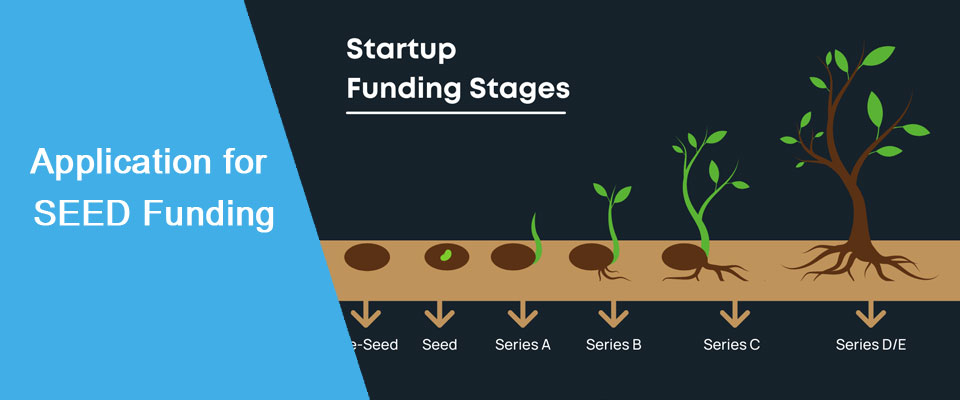
APPLICATION FOR SEED FUNDING
1. Introduction
Seed Funding refers to the initial financial support provided to early-stage start-ups or innovation-driven enterprises to help them develop prototypes, conduct research, validate ideas, or launch pilot versions of their products/services. It is typically provided by government schemes, incubators, angel investors, venture funds, or Start-up India Seed Fund Scheme (SISFS).
2. Purpose of Seed Funding
Seed funding is aimed at supporting:
- Product development
- Prototype development and testing
- Market research & validation
- Business model development
- Technology upgradation
- MVP (Minimum Viable Product) creation
- Early-stage operations and team building
3. Eligibility Criteria
Depending on the scheme/incubator, general eligibility includes:
- Entity must be a Private Limited Company / LLP / Registered Start-up.
- Should be DPIIT-recognized Start-up (for SISFS and similar schemes).
- Business must be innovation-driven and technology-based.
- The start-up should be less than 2 or 5 years (varies by scheme).
- Must not have received more than a defined amount of funding earlier.
- Should have a well-defined business plan or prototype.
4. Documents Required for Seed Funding Application
- Certificate of Incorporation
- DPIIT Start-up Recognition Certificate (if applicable)
- Founders’ KYC (PAN, Aadhaar)
- Pitch Deck
- Business Plan / Project Report
- Financial Projections (3–5 years)
- Bank Details / Cancelled Cheque
- Prototype images / website link / demo video
- Shareholding pattern
- Previous funding details (if any)
- Innovation write-up
- Market analysis & revenue model
5. Key Components of a Strong Seed Funding Application
- Problem Statement:
Clear description of the problem your product/service solves. - Innovation & Uniqueness:
What makes your solution innovative or different from competitors? - Prototype Stage:
Current development progress—MVP, prototype, sample, or demo version. - Target Market:
Size, audience, demand, and potential growth opportunities. - Business & Revenue Model:
How the start-up plans to earn revenue and sustain growth. - Financial Requirement:
Precise requirement of seed funding and how it will be used (break-up). - Team Profile:
Experience and qualifications of the founders and core team members.
6. Broad Process of Applying for Seed Funding
- Identify suitable schemes or incubators offering seed funding.
- Prepare required documents—pitch deck, innovation write-up, projections.
- Apply online through the portal or incubator website.
- Upload required documents and fill the seed funding application form.
- Screening by committee or incubator experts.
- Pitch presentation / personal interview.
- Approval and signing of funding agreement.
- Release of funds in stages (milestone-based).
7. Government Schemes for Seed Funding
- DPIIT – Start-up India Seed Fund Scheme (SISFS)
- MSME Idea Innovation Scheme
- BIOS – Biotechnology Ignition Grant (BIG)
- Startup Bengal / Startup Odisha / State Startup Schemes
- Technology Development Board (TDB) Support
- Incubator-based seed funding schemes (TIH, TBI, NIDHI-PRAYAS, etc.)
8. Advantages of Seed Funding
- Helps start-ups develop prototypes without financial pressure
- Reduces early-stage financial risk
- Enables market validation and pilot testing
- Improves chances of future venture capital or angel investment
- Provides mentorship, incubation, and networking support
- Helps build core team and infrastructure
9. Common Reasons for Rejection
- Weak explanation of innovation
- Unclear financial planning
- Lack of prototype or proof of concept
- Unorganised pitch deck
- Unrealistic revenue projections
- Poor team structure
- Copying or non-unique business idea
10. Conclusion
A strong seed funding application requires clarity of innovation, solid business model, realistic financial planning, and a compelling pitch. Start-up founders must prepare all documents professionally and ensure their prototype and market potential are clearly demonstrated to secure government or private seed funding.
Get in Touch
Recent Services
- Digital Signature Certificate (DSC)
- GST Registration
- Income Tax Return (ITR 1 to 7)
- Loan Documentation
- PAN Services